Time Travel Isn’t Science Fiction. It’s Perspective.
There’s a moment—if you’ve ever experienced it—where time seems to loosen its grip.
You hear a song you haven’t heard in twenty years and suddenly you’re not sitting where you are anymore. You’re somewhere else entirely. A different room. A different version of yourself. Same consciousness, different coordinates. The years in between collapse as if they never existed. That feeling—disorienting, powerful, almost sacred—is what I was chasing when I wrote Time Travel.
Not the Hollywood version with machines and paradoxes and alternate timelines. Not the clean, mechanical fiction of jumping from point A to point B. Something much more subtle. Something we already experience but don’t fully understand. Because if you step back for a second, the idea that time is fixed, linear, and absolute is starting to look less like a fact… and more like an assumption.
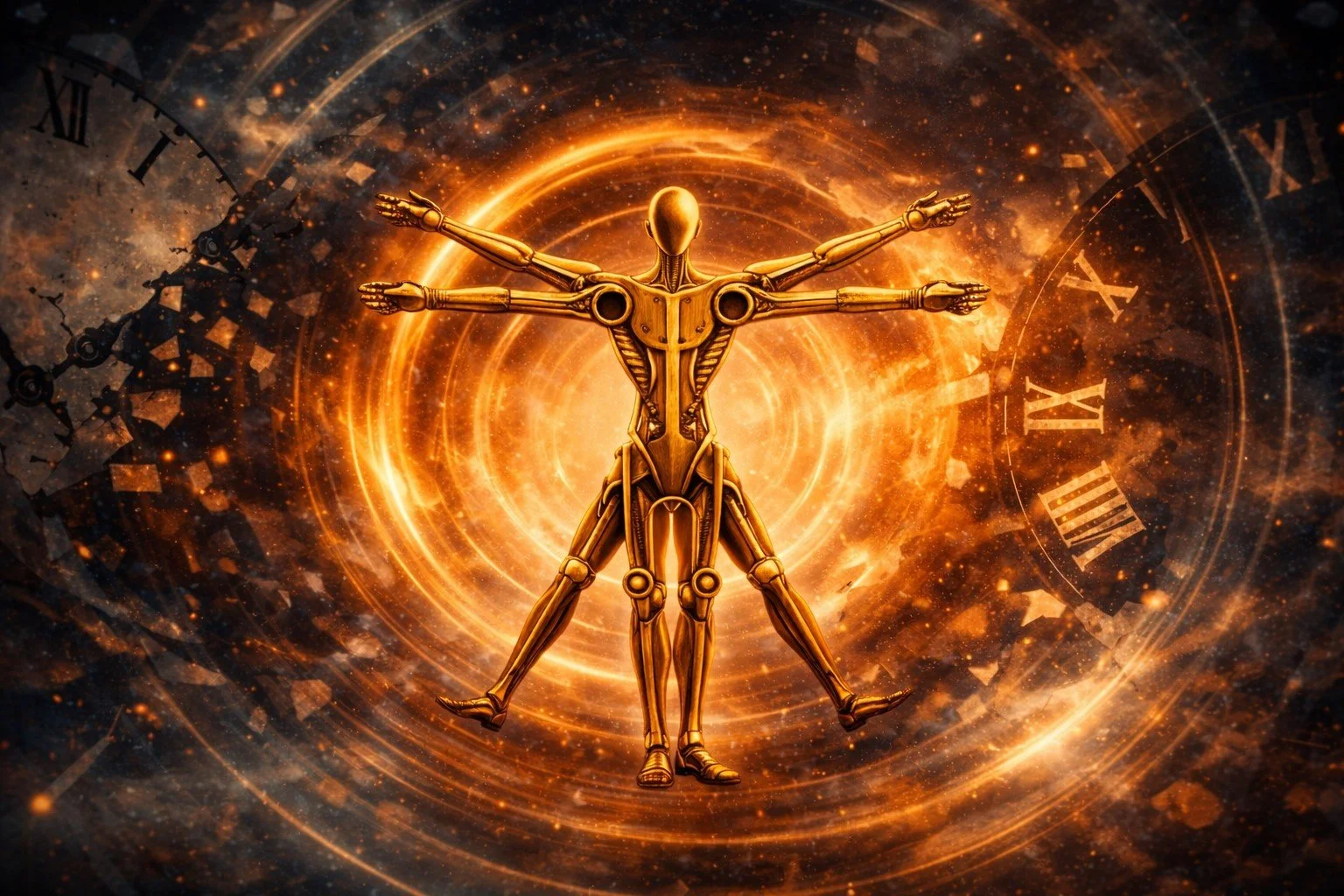
Modern physics has been quietly dismantling that assumption for over a century. Einstein’s theory of relativity tells us that time is not constant. It bends. It stretches. It slows down and speeds up depending on velocity and gravity. Two observers can experience time differently depending on where they are and how they move. In other words, time isn’t a rigid track—it’s more like a field.
And if time is a field, then maybe what we perceive as “movement through time” is something closer to navigation within it. That’s where things get interesting. Because once you start thinking this way, you realize that the boundary between science and experience begins to blur. Memory isn’t just recall—it’s re-entry. Emotion isn’t just feeling—it’s activation. And music… music becomes a kind of access point. A trigger. A key.
The Sound of a Moment Collapsing
Time Travel started with a simple idea: what would it sound like if time folded in on itself? Not lyrically, at least not at first. Sonically. I wanted a track that didn’t just move forward in a straight line but felt like it was constantly pulling you backward and forward at the same time. A sense of motion layered over stillness. A pulse that suggests momentum, but with textures that feel suspended—almost outside of time.
That’s where the cinematic elements came in. Wide stereo fields. Atmospheric synths. Guitars that don’t just sit in the mix but stretch across it. Everything designed to create a sense of space—not just physical space, but temporal space. The feeling that you’re not just listening to a song, but moving through something.
There’s a reason film composers think this way. Music has always been one of the few mediums capable of manipulating time perception directly. A three-minute piece can feel like thirty seconds or an eternity depending on how it’s constructed.
So, the goal wasn’t just to write a song. It was to build an experience that subtly alters how time feels while you’re inside it. Because once that happens—once your perception shifts—even slightly—you’re already doing something that starts to resemble time travel.
The Deeper Question
But beneath all of that—the sound design, the physics, the concept—there’s a more fundamental question that sits at the center of Time Travel: What if time isn’t something we move through… but something that moves through us?
That idea isn’t new. Philosophers have wrestled with it for centuries. Mystics have hinted at it in different ways across cultures. Even ancient traditions suggested that time might be cyclical, layered, or illusionary rather than strictly linear. Zoroaster, the ancient Persian prophet, suggested that events are not merely experienced once, but are in some sense re-enacted. Not in a literal replay, but in a pattern-based recurrence—echoes across time.
Now fast forward to today, and you have scientists talking about block universe theory, where past, present, and future all coexist simultaneously. Time doesn’t “flow”—we simply experience it sequentially. If that’s true, then every moment you’ve ever lived still exists somewhere in the structure of reality, which means the feeling of “going back” might not be imagination. It might be access.
Music as a Portal
This is where music becomes more than entertainment. It becomes a bridge. There’s something about sound—especially layered, emotionally resonant sound—that bypasses our normal filters. It doesn’t just speak to the analytical mind; it connects directly to memory, emotion, and identity. That’s why a song can take you somewhere instantly. Not metaphorically. Neurologically.
Your brain reactivates the same pathways associated with that original experience. Your body responds. Your emotional state shifts. Your perception changes. You are, in a very real sense, inhabiting another moment. And if that’s not time travel, it’s at least a close cousin.
The Strange Coalition Idea
This is also where the broader concept of Strange Coalition comes into play.
The name itself reflects something I’ve been exploring for a while—the idea that seemingly unrelated elements can combine into something coherent, even powerful. Different musical styles. Different influences. Different ways of thinking about reality. Rock, blues, metal, folk, reggae, country and jazz—each has its own structure, its own rhythm, its own history. But when you bring them together in the right way, they don’t cancel each other out. They expand the possibilities.
The same is true of ideas. Science and philosophy. Physics and experience. Ancient thought and modern theory. None of these have to exist in isolation. In fact, the most interesting insights often come from the intersections. Time Travel sits right in that intersection. It’s not trying to prove anything. It’s not making a scientific claim. It’s asking a question—and inviting you to feel your way through it.
A Moment to Listen
If you’ve read this far, you’re already tuned into the idea behind the track. Now I’d encourage you to experience it the way it was intended—through the music itself.
Take a few minutes, put on headphones if you can, and listen to Time Travel. Let it play without distraction. Pay attention to how it feels as much as how it sounds. Notice if your sense of time shifts, even slightly.
And if it resonates with you, I’d really appreciate your support:
👉 Listen to Time Travel on YouTube, Spotify and Apple Music
👉 Give it a like or add it to your library
👉 Share it with someone who might connect with it
That kind of engagement makes a real difference—especially at this stage—and helps the music reach people who are open to it.
Where This Is Going
Time Travel isn’t just a standalone track. It’s part of a larger creative thread that runs through everything I’m working on right now—music, writing, and the broader narrative ideas behind human existence. At the core of that project is a similar tension: the sense that reality might be more structured, more patterned, and more interconnected than it appears on the surface. That what we experience as randomness might actually be something else entirely. That human history is much more ancient and complex than our current understanding. That we are probably not alone in the universe. Time is central to that idea.
Because if time behaves differently than we think, then everything built on top of our assumptions about time—cause and effect, progress, history, even identity—starts to shift. And when that happens, the line between science and story begins to blur. That’s where things get interesting.
Final Thought
You don’t need a machine to travel through time. You’ve already done it. Every memory you’ve revisited. Every moment that came rushing back. Every Deja Vu and coincidence. Every time music pulled you somewhere else—you’ve experienced the edges of something deeper. Maybe we just don’t have the language for it yet.
Or maybe we do… and we’ve been calling it something else all along.