America 250: Don't Bend the Knee
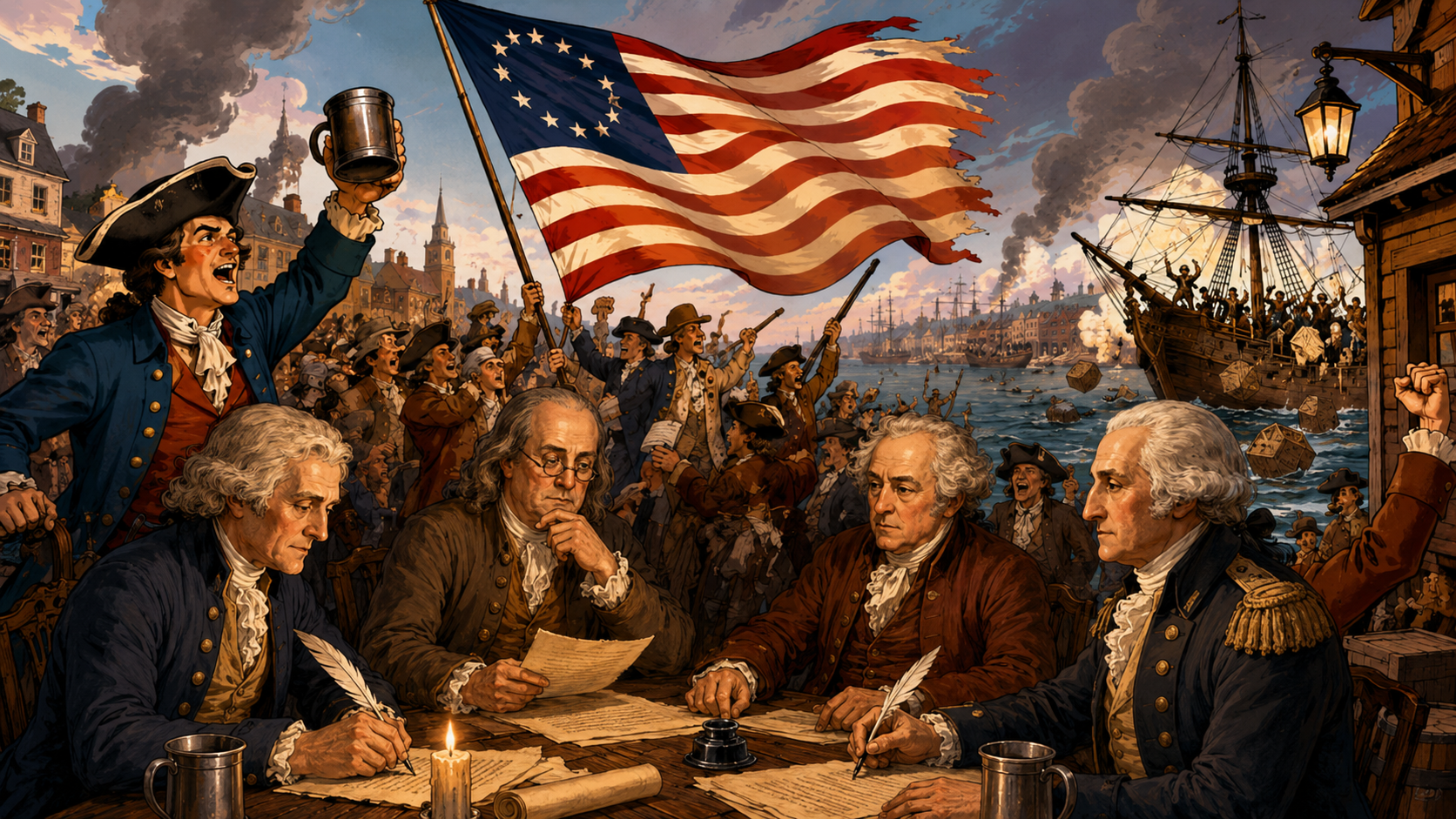
My new Strange Coalition song, “Cyrus,” has just been released today on Spotify, Apple, and anywhere you stream music. There is also a video on my YouTube channel where I perform the song in a cool AI-created English pub. I’m releasing the song just in time for the anniversary of our American independence celebration. It was 250 years ago tomorrow that 13 imperfect British colonies declared themselves a sovereign nation independent from the greatest empire the world had ever known. The Declaration of Independence was based on recognition of the “self-evident” truth that all humans were created equal and were entitled by their Creator to “life, liberty and the pursuit of happiness.” This groundbreaking social innovation created the baseline from which the United States became the most prosperous, generous and powerful empire the world has ever known. It’s an empire “of the people, by the people and for the people”, not a king, or a single political party. It has raised the living standards of its citizens more an any nation or empire in history by far. Plenty of warts and corrections for sure, but still no country can hold a candle to us.
When asked what he and the other founders had created with the signing of the Constitution, Benjamin Franklin famously said, “A republic, if you can keep it.” That statement is my inspiration for “Cyrus”. It’s a rowdy political ballad, done in an Irish/English folk style, that probably could have also been at home in a colonial New England public house full of Son’s of Liberty rabble rousers. Or maybe a London pub today? It’s the kind of song that should probably be heard with a few friends banging on the table, howling with laughter singing a chorus simple enough that everyone can join in before they fully understand what they’re singing. This last part matters because “Cyrus” is not a history lecture. It is not a solemn folk song about ancient Persia. It’s a drinking song with a knife under the table.
The main character is Cyrus the Great, King of Persia, conqueror of Babylon, and one of the more fascinating figures in ancient history. He was a ruler big enough to appear not only in history books, but in the Bible, and not as a villain either. That’s the interesting part. Cyrus is remembered with admiration because after taking Babylon, he allowed the Jews to return from captivity. He is associated with liberation, restoration, and the end of exile. That’s a remarkable legacy for any conqueror, especially one who ruled in the brutal world of ancient empires.
But let’s not get carried away. Cyrus was still a conqueror. He still came with armies and took lands that were not his. He still built an empire and required submission from the people he conquered. Maybe he was more tolerant than others. Maybe he was shrewder and understood that letting people keep their gods, customs, and local identities was a better way to run an empire than grinding everyone into dust. But empire is still empire and that contradiction is what hooked me. The song is sung from Cyrus’s point of view. Not as a dusty historical king, but as a swaggering, half-charming, half-menacing political figure who knows exactly what he’s doing. He is not sneaking into town. He comes right out and says it:
My name is Cyrus and
I’ve come for your lands
Maybe you’ve heard of my name.
From the north and the south, the east and the west
I’m known with great fear and great fame.
There is a little comedy in that. I wanted him to sound like the villain in an old pub ballad. A man so confident in his own power that he doesn’t bother pretending to be humble. But underneath that swagger is the thing I find most notable about history. That power rarely sells itself as power. It sells itself as mercy, stability and rescue. And sometimes, to make the whole thing more confusing, it really does rescue someone. That’s why Cyrus is a useful figure for a song like this. If I had chosen some cartoon tyrant, the point would be too easy. Everyone knows to distrust the monster who looks like a monster. The harder problem is the ruler who does something good, offers something valuable, restores something lost, and then quietly presents the bill. It’s the ancient bargain:
I’m here with an offer that you can’t refuse
And it might almost feel like it’s free
I’ll spare all your lives,
Your children, your wives
I ask only you bend the knee.
That is the whole authoritarian transaction in a nutshell. You get to live. You get order and protection and maybe some kind of justice. Maybe the new ruler is better than the old one. Maybe the trains run on time, the streets safer, and the chaos stops. All you have to do is bend the knee. Just a little. Just this once.
Of course, no society usually hands over its freedom all at once because that would be too obvious. People are not usually asked to surrender everything in a single dramatic moment with trumpets and a ticker tape parade. It happens in installments. A law here. An emergency power there. A new speech code. A new justification. A new category of people who must be managed for their own good. Different rules for different classes of citizens. And people are told not to worry because it’s all for safety, equality, stability, compassion, progress and even democracy. Pick the word of the moment. The words change but the direction doesn’t.
More centralization and dependency. More people being told that the right thing to do is comply. And here is the uncomfortable part. People often do comply, and not always because they’re cowards. Sometimes they’re tired or have been taught that independence is selfish or that they no longer believe they have the right to say “No”. Sometimes the deal really does look pretty good compared to the chaos around them. That’s how the cage gets built. Not always by force. Sometimes by invitation as my song alludes to:
So gimme your wings
Cuz I won’t let you fly
But behave and I might let you sing
Cages are made for pretty little birds
And that’s what the future will bring
That’s probably the line that best explains the song. A caged bird can still sing. That’s the trick. Authoritarian systems don’t always silence everyone. Many of them allow music, art, slogans, rituals, festivals, approved criticism, permitted comedy, and carefully managed forms of dissent. People can still make noise. They can still entertain themselves. They can still feel expressive. But singing is not flying. Flying is different. Flying means movement. Risk. Direction. Escape. Choice. Consequence. Responsibility. A bird that can sing but not fly may still sound alive, but it’s no longer free in the way a bird is meant to be free.
We live in a time where people are constantly expressing themselves and often less powerfully than they think. Everyone’s got a platform and an opinion. They post, signal, argue, perform, mock, praise, condemn, and confess. It can feel like freedom because it’s noisy. But noise isn’t power. Expression is not sovereignty. Participation in a managed system is not the same thing as self-governance.
Across the world, authority is expanding, and not just in obvious dictatorships. That part is easy to see. The more difficult thing to admit is that authority expands in democracies too. It expands through bureaucracy, courts, emergencies, executive orders, security apparatus, financial controls, and international regulatory regimes that no ordinary citizen can possibly understand, much less control. This is not a left-right problem in any simple sense. People of all political stripes discover the danger of centralized power only when the other side controls it. Then, when their side gets a turn, the danger suddenly becomes a useful tool. That’s human nature and human nature is why governments need limits. Not because all it’s evil. Government is necessary because law and order matters. Defense matters. Public health matters. A functioning society cannot exist on slogans about freedom alone. Anyone who says otherwise is badly misinformed or selling a different kind of fantasy.
Power is still power, even when it’s doing something necessary. Because necessary power is the easiest power to defend. No one has to invent a scary argument for it. It arrives with a crisis already attached: war, pandemic, financial collapse, crime wave, terrorist attack, technology panic, climate panic. Some of the problems are real. Some are exaggerated. Some are invented. But all of them can be used. That’s why free societies have to be careful not only with bad rulers, but with good intentions. Good intentions are often the smoothest road to permanent authority. A program begins as temporary relief and then becomes a constituency. Then it becomes a department and a funding stream. And then a moral obligation. Then it becomes politically untouchable and finally part of the furniture of the state. Multiply that by a million and presto. You have the modern administrative state, with a $40 trillion price tag to boot.
No one person planned it all. No single villain built the machine. The leviathan grows because every part of it has its own logic, defenders, beneficiaries, and vocabulary of virtue. And somewhere along the way, ordinary people begin to “bend the knee” without even noticing their posture. That’s what I wanted Cyrus to say out loud. In the second half of the song, he asks the question that conquerors probably understand better than the conquered:
Why have I come from so far away
to take what I know isn’t mine?
But asking that question
You don’t understand
the riddle of your own decline.
That’s the line I keep coming back to. The conquered people want to know why Cyrus has come. But Cyrus tells them they are asking the wrong question. The real question is, “Why were you conquerable in the first place?” That question applies to nations, but also to cultures, institutions, families, companies, and individuals. Decline usually begins before the invader arrives. By the time the gates fall, the deeper failure has already happened. A society forgets what made it strong, and the habits of discipline, gratitude, courage that once held it together. It forgets that freedom requires adults, not permanent children supervised by an ever-expanding state. It forgets that prosperity is not magic and that a culture cannot live forever by spending down inherited capital without replenishing it.
Now the conqueror appears. Maybe with an army. Maybe with a ballot. Maybe with a bureaucracy. Maybe with a smile. Cyrus says it without pulling any punches:
There was a time
a great people you were
and many of us followed along.
But like all great nations that came before you
You’ve forgotten that which made you strong.
The lyrics don’t apply to any one country. It’s a pattern. Babylon, Persia, Rome, Britain, Europe, China, America, whatever comes next. The names change but the human problem remains. Every empire believes it’s different and that it has solved the old weaknesses. Every empire thinks its managers are wiser, its systems more advanced, and moral mission more enlightened, its enemies more dangerous, and its people more in need of control.
But eventually, every empire collapses under its own weight. Convinced of its permanence, it surrounds itself with sycophants that are too insulated from reality and busy trying to manage the world to notice the foundation cracking under their own feet. The trappings of power do strange things to people. They convince the few that they are entitled to rule the many and that outsiders are dangerous. Empire loyalists turn disagreement into disloyalty and administration into identity. They turn privilege into expertise and self-interest into public service language. Citizens become subjects to be managed. That’s when politics becomes creepy because the people in charge stop sounding like representatives and start sounding like tutors. They don’t just want to govern your conduct. They want to improve your soul and teach you what to think, what to fear and admire, what to apologize for, and what to celebrate.
The final lines of my tune go to this thought directly:
So don’t be a fool, just submit to my rule
And I’ll teach you what’s wrong and what’s right.
And I’ll teach you what’s wrong and what’s right.
And I’ll teach you what’s wrong and what’s right.
That repetition is meant to get under your skin because the conqueror doesn’t simply want obedience. Obedience is useful, but it’s not enough. The real prize is moral authority. The ruler wants the conquered to agree that submission is maturity and dependence is virtuous. At that point, power has moved from law into conscience. Dangerous territory indeed. And the chorus creates the envelope:
La La La Da Da Da
La La La Da Da Da
Do you like that contrast? A dark warning wrapped in a pub chant? Something ugly made singable. Maybe that’s how political songs should work. If you only lecture people, they tune you out. But give them a catchy chorus and the idea might sneak in through the back door. There is also something honest about people singing during decline. We do it all the time. We doom scroll and obsess over celebrities, sports, markets, scandals, gadgets, and the outrage of the week. We turn everything into entertainment because entertainment is easier than responsibility.
I am as guilty of this as anyone. Maybe that’s why I wanted the song to be rowdy rather than solemn. Solemn warnings often sound like someone else’s problem. A pub song feels closer to the truth. Civilizations don’t always collapse in silence. Sometimes the band is still playing and everyone is still having a pretty good time. Until they aren’t.
Try not to think of “Cyrus” as a pessimistic song, but more like a suspicious song. Suspicion, in moderation, is a civic virtue. We should be suspicious of rulers bearing gifts. Suspicious of experts who hate being questioned and politicians who define freedom as obedience to their agenda. Be wary of emergencies that never quite end. Notice how moral language is attached to coercive power. Be skeptical of a political party that shouts “No More Kings” while brazenly planning to pack the courts to consolidate its own power. We need to be skeptical of any authority that says, “give me your wings and I might let you sing.”
This doesn’t mean rejecting every institution or assuming every leader is corrupt. Cynicism can become its own form of laziness. The answer to bad authority is not chaos. The answer is to get out there and vote and engage in the kind of civil discourse that a thriving democratic republic requires. For America, the answer is abiding by our brilliant Constitution and it’s system of free speech, checks and balances, decentralization and transparency. America has always been a culture strong enough to say “No” by embracing the Declaration of Independence call to action:
“That whenever any Form of Government becomes destructive of these ends, it is the Right of the People to alter or to abolish it, and to institute new Government…”
Our American founders knew this. I wrote a book 7 years ago, Locally Grown: The Art of Sustainable Government, that reaffirms the strength of our founding vision. These timeless lessons are needed more than ever, especially in our schools. Let’s remember that freedom is not a natural resting state. It has to be taught and practiced. It has to be defended not only against obvious tyrants, but against attractive bargains. Especially attractive bargains. Because Cyrus does not arrive saying, “I am here to enslave you.” He arrives saying, “I can end your trouble and restore order.” He says, “I know what is wrong and what is right.” And maybe, for a while, he does. But that’s what makes the warning worth singing.
Make it a point to listen to “Cyrus” this holiday weekend. Sing it loud and proud at your backyard barbecues and July 4th parties as a reminder that we had to fight for the freedom we enjoy and that we may need to do so again to keep it.
In the meantime, hoist a glass and let’s wish each other a happy 250th birthday America!