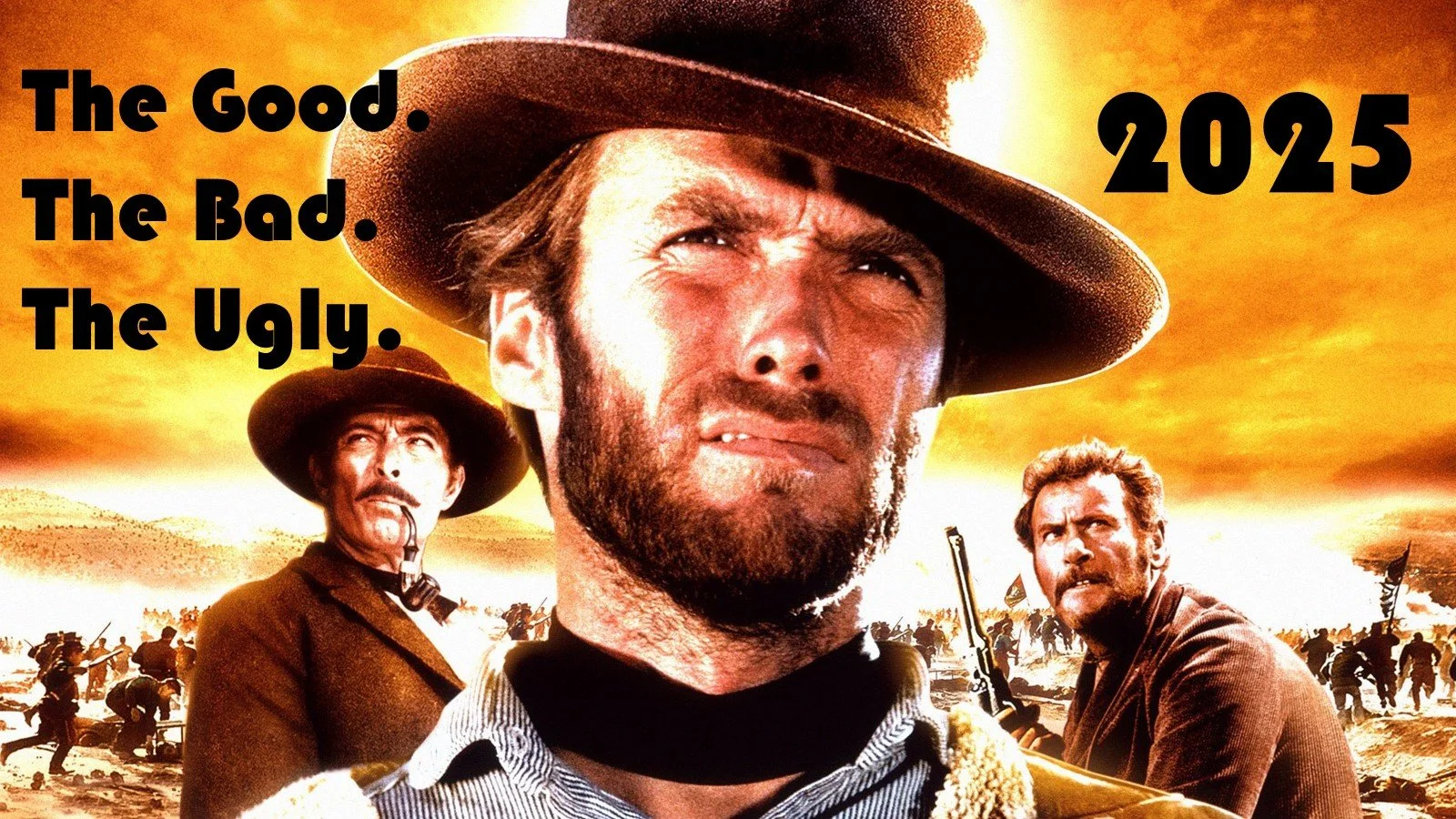
2025: The Good, the Bad, the Ugly
2025 did not feel like a normal year. It felt like a reckoning—political, economic, cultural, and moral—arriving all at once. Institutions that demanded deference lost authority, long-standing assumptions cracked under pressure, and voters across the Western world signaled that patience had run out. What had been sold for years as “settled,” “inevitable,” or “beyond debate” suddenly wasn’t. From inflation and borders to war, energy, and free speech, the distance between official narratives and lived reality became impossible to ignore. The result was not calm reform but a sharp correction, driven less by ideology than by exhaustion.
This post is an attempt to take stock—honestly—of a year that reshaped the trajectory of the United States and much of the world. There were real gains and undeniable failures, moments of clarity alongside bouts of dysfunction and moral decay. Some outcomes were encouraging, others alarming, and several remain unresolved. What follows is a clear-eyed assessment of the good, the bad, and the ugly of 2025—written not to inflame, but to understand how we arrived here, and what that means for the fragile years ahead.
The Good
Donald Trump Became the 47th President of the United States
For all you folks who hate the man, don’t stop reading because I take him to task plenty further on here. However, the facts are that four years of the Democrat policies under Joe Biden were insane, and such a radical swing to the left triggered a strong swing in the opposite direction. Open borders, boys can be girls and girls can be boys, white people are evil, inflation driven by government spending, blatant weaponization of the DOJ, ever-expanding federal government. This all was obvious to a clear majority of the country who held their noses and voted for Donald Trump.
DOGE Turns on the Light and the Cockroaches Scatter
Think what you like about Elon Musk, but he gets stuff done. He broke down seemingly impenetrable barriers of the administrative state and exposed the corruption that festers in a bloated government treasury. Turns out that despite its mission of providing aid to deserving countries, USAID has for years been a secret slush fund for the Democrat party to advance many of the sick policies mentioned above. Even after uncovering plenty of evidence of fraud in our entitlement payments system, too many politicians refuse reforms because more than half our citizens, and a lot of non-citizens receive government checks. Social Security, Medicare, Medicaid, food, stamps, housing and Obamacare subsidies, all across party lines.
Still, as someone who fervently believes in the actual bottom up, governing architecture are founders gifted us, the DOGE attempt represents important progress in bringing our federal government back within its constitutional boundaries. Hopefully it creates a backdrop that can be built upon by a future conservative administration.
No More Open Borders
It stuns me how most in the Democrat party cares more about illegal immigrants than they do about American citizens. Subsidized luxury hotels in New York City while veterans sleep homeless on the street. Funneling of federal entitlement money to illegals through the opaque tunnels the Democrats built decades ago. Everyone saw our already failing public schools buckle under the pressure from the millions of non-English speaking kids in our school system taking resources from our own kids. The multi-billion-dollar entitlement fraud perpetrated by Somali immigrants in Minnesota with the tacit approval of Governor Tim Walz occurred because they are an important voting block for his party in that state. Drug trafficking, sex trafficking, good old-fashioned street crime, is all a small price to pay for the strategic goal of importing a new political base that will be beholden to taxpayer subsidies. Under the Biden administration, folks who observed this, were labeled racists, bigots, fascists and Nazis. Ad hominem attacks are par for the course.
We are a nation of immigrants, and the diversity it brings remains a pillar of our American strength, but we have a few basic rules that have existed for 250 years. As a sovereign nation, we get to choose who comes here. You can’t game our asylum laws, not learn English, or try to undermine our political system, or commit crimes, and be expected to stay here.
The Narco-Terrorist Regime in Venezuela is Finally Getting Justice
Nicolas Maduro, like Chavez before him, and like Fidel Castro before him has been a professional country destroyer. Venezuela was traditionally the richest country in South America and now it’s become the poorest. Millions have fled to other countries, including the United States. Maduro pays for his terror industrial complex against his own people by acting as a middleman for the flow of poisonous drugs into the United States. This fits nicely in the strategy of our adversaries of weakening and replacing America on the world stage, which is why Cuba, Columbia, and Venezuela have become important allies of our adversaries, China, Russia, Iran and North Korea. I think it is good for our country that we have a naval battle group in the Gulf blowing narco-speedboats out of the water and commandeering sanctioned China-bound oil tankers. Getting rid of the narco-Marxists in Venezuela and Cuba would be great for their people and for the world.
The Frankenstein Regimes in Iran, Lebanon, Yemen and Gaza Have Been Slapped Hard
The “river to the sea” sea crowd, including some in the United States, finally got their comeuppance. Hamas is a terrorist organization of the worst kind. Their mission statement is to eradicate Israel, and they will lie, rape, torture and murder their way to that goal, while their international enablers in the UN and Europe provide aid and diplomatic cover. The world got another taste of the Hamas modus operandi with their heinous October 7, 2023, attack where they murdered over 1,200 Israeli civilians and took 250 hostages. Israeli acted with justified outrage to retaliate in eliminating Hamas whose main defense strategy is to use their own people as human shields in mosques, schools and hospitals. This has resulted in the deaths of 70,000 Hamas terrorists and Gaza civilians. In an attempt to cut off the head of the snake, Israel and the US retaliated and has all but destroyed the Iranian nuclear weapons program that has been allowed to grow by the last 3 Presidential administrations.
You cannot negotiate with bullies and thugs. Only force is recognized and I am glad the US has applied that force to set back these civilizational nihilists for a long while. The result has been what seems like a viable peace plan brokered by Trump that provides security for Israel, and a non-Hamas path to Palestinian statehood that has the support of many key Arab neighbors. But Hamas has refused to disarm so we will see where this goes.
Climate Alarmism is Exposed
Donald Trump's calling out and taking actions against the climate fraud in the US, made it safe for citizens in Europe and elsewhere to also speak out. The result was a broad popular revolt against climate alarmism—not as climate denial, but as resistance to a style of politics that many felt had crossed from science into ideology. For years, governments, corporations, and media outlets framed climate change as an imminent apocalypse requiring permanent emergency powers. Net-zero mandates, carbon taxes, diesel bans, and restrictions on farming and home energy were imposed with little public consent, often justified by worst-case scenarios that failed to materialize on the promised timelines. By 2025, fatigue had set in. Rising energy prices, inflation, and supply-chain fragility made abstract climate goals feel disconnected from everyday survival.
The revolt did not come from a single ideology. It emerged simultaneously from working-class voters hit hardest by fuel and food costs, farmers facing regulatory extinction, engineers frustrated by technically unrealistic targets, and younger voters disillusioned by years of catastrophe messaging that delivered anxiety rather than solutions. Social media amplified these voices, exposing internal contradictions—private jets for climate summits, fossil-fuel reliance hidden inside “green” technologies, and emissions exported rather than reduced.
Crucially, the backlash was not anti-environment. It was anti-alarmism. Polls showed continued support for clean air, conservation, and pragmatic emissions reduction, but collapsing trust in institutions that treated dissent as heresy. When blackouts, grid failures, and rolling energy shortages appeared in regions that had moved fastest on renewables without backup capacity, skepticism hardened into opposition. Politically, 2025 marked the moment when “climate emergency” rhetoric stopped winning elections by default. Candidates began distancing themselves from bans and mandates, reframing climate policy around resilience, innovation, nuclear power, and adaptation rather than sacrifice. The language shifted from “there is no alternative” to “what actually works.”
The revolt succeeded not by rejecting science, but by demanding honesty: uncertainty acknowledged, costs counted, trade-offs debated. In doing so, it signaled a broader democratic correction—proof that even well-intentioned movements lose legitimacy when fear replaces consent.
Europe is Finally Taking Responsibility for its Own Defense.
Donald Trump’s approach toward Europe—often blunt, transactional, and unapologetically critical—forced a long-overdue reckoning over the continent’s reliance on American defense guarantees. By repeatedly pressing NATO allies to meet their agreed-upon defense spending targets and questioning the automatic nature of U.S. protection, Trump challenged a comfortable status quo that had persisted since the Cold War. While his rhetoric unsettled European leaders, it also removed the illusion that U.S. military backing was unconditional or permanent. In response, most European nations have increased defense budgets, modernized forces, and began speaking more seriously about strategic autonomy and collective responsibility. Whatever one thinks of his style, Trump’s pressure accelerated a shift toward Europe taking ownership of its own security rather than assuming the United States would indefinitely shoulder the burden.
The Bad
Ukraine War Grinds On.
This an area where Trump has not done much better than Biden so far. Putin is an evil revisionist murderous thug, and thugs aren't swayed by sweet-talk diplomacy. It does look like he’s finally putting economic pressure on Putin, but it has taken way too long. Trump is brokering a peace deal that requires Ukraine to give up 20% of its country, forswear joining NATO and limit it's military. These are Russian talking points. The Russian economy is in shambles, and the US must lead the kind of hard sanctions that can push them over the edge and put pressure on Putin to settle for peace.
The Inflation Dragon is Still at Large
The ironically and hilariously named Inflation Reduction Act, the Biden Administration's signature accomplishment dropped trillions in federal dollars into the economy that resulted in a new era of inflation that climbed as high as 9% and has proven difficult to shake. Trump's tariffs have not helped either by raising the cost of imported goods across the board. Inflation is and has always been a disease of hyperactive government policy. Sadly, it seems like the Fed is all but resigned itself to the fact that 3% annual inflation will become the new normal as the federal government prints increasingly more money to finance increasingly unsustainable deficits driven by unsustainable public entitlements. And even more sadly, the 3% will turn into 4% and higher until our currency breaks. This is not theoretical. Over 13 years, 3% annual inflation cuts your purchasing power in half.
The bottom line is that things are unaffordable because of persistent inflation that is intentionally created by our government through the Fed, to “monetize” our unsustainable $38 trillion federal debt. A fancy way to say money printing. Inflation is created by our government. It makes your money worth less. It’s why hard assets like stocks, real estate, precious metals and art have all gone way up over the past several years.
US Military is Woefully Underfunded to Meet the New Threats
The U.S. military faces a growing gap between its resources and the demands of the modern threat environment. While defense spending remains high in absolute terms, much of it is absorbed by personnel costs, healthcare, legacy systems, and inflation, leaving too little for modernization and readiness. Aging equipment, limited munitions stockpiles, delayed shipbuilding, and stressed maintenance cycles point to a force that is increasingly stretched, even as the Department of Defense warns it cannot deter multiple major adversaries under current funding trajectories. To put into perspective the national security threat our unsustainable federal deficit has become, interest on the national debt exceeded $1 trillion in 2025 which means we spend more on debt-service than our defense. Without entitlement reform, this dangerous doom loop will only get worse fast.
At the same time, the military remains oriented toward past conflicts rather than emerging ones. Procurement and doctrine still emphasize traditional platforms, while adversaries such as China and Russia focus on cyber, space, hypersonic missiles, autonomous weapons, and gray-zone warfare designed to exploit U.S. vulnerabilities. Without faster adaptation and a sharper focus on next-generation capabilities, the United States risks fielding a force that is expensive, experienced—and increasingly mismatched to the wars it is most likely to face. Unfortunately, President Trump's new Department of War moniker doesn't make us tougher and so far I don’t see the kind of commitment and leadership we need from his administration or Congress.
Younger Generations are Falling Behind
Sadly, upward mobility is becoming increasingly out of reach for our kids and grandkids. Demographics around the world are crumbling because kids are not having kids because they find housing and the basics of life unaffordable. I wrote about this sad phenomenon in a September blog post entitled, The Boomers Took it All. Time to Give Some Back.
The post-World War II Baby Boomer generation benefited from a unique set of economic circumstances—affordable college, plentiful jobs, rising wages, and accessible homeownership—that enabled unprecedented wealth accumulation and upward mobility. This historical advantage helped Boomers secure substantial real estate equity and expanded public benefits like Social Security and Medicare, providing financial security in retirement. The most important assumption in place during the formation of these programs decades ago is no longer true. We don't have enough younger workers paying taxes for the systems to support them. These same systems have become structural barriers for younger generations, as Millennials and Gen Z face stagnant wages, crushing student debt, unaffordable housing, rising federal debt, and inflation that erode economic mobility and undermine the traditional American Dream.
The current generational imbalance isn’t inevitable but a result of policy choices and regulatory burdens that lock younger families out of wealth-building opportunities. To address this inequity, we need reforms like streamlining housing regulations, reducing impact fees, reforming entitlements, and revitalizing education affordability and support policies that restore opportunity and economic dynamism for future generations. Just take a look at Europe if you are curious how this will look a decade down the road without reforms.
The Ugly
Donald Trump
Donald Trump's personality, and sketchy past continue to be his own worst enemy. While I agree with most of his policies, he does himself no favors with his personal attacks, late night social media outbursts and unseemly way his family is profiting from his presidency. These contradictions have long defined Trump’s public life: a capacity to articulate grievances many voters recognize, paired with a temperament that repeatedly undercuts his own agenda. His impulse to personalize every conflict turns structural debates into soap operas, shifting attention from policy outcomes to spectacle. Each late-night post or gratuitous insult reactivates doubts among otherwise sympathetic supporters, giving opponents easy ammunition and distracts from arguments that might otherwise stand on their own merits. Did he really have to put his own name on the Kennedy Center or our newest class of aircraft carriers? Even with all this baggage, the Democrat corruption demonstrated Trump was still the better choice.
Jeffrey Epstein Files
The release of documents connected to Jeffrey Epstein offered a rare, unfiltered glimpse into how American politicians, financiers, and cultural power brokers often behave when public scrutiny is absent. Stripped with press conferences, prepared talking points, and reputational armor, the records revealed a world governed less by ideology or public service than by access, indulgence, and mutual protection. What stood out was not merely the depravity associated with Epstein himself, but the casual proximity of influence to moral rot—where proximity to wealth and status blurred ethical boundaries and normalized behavior that would be career-ending for ordinary citizens. The documents reinforced a long-held suspicion: that elite accountability in America is selective, negotiated privately, and rarely proportional to the offense.
Equally disturbing was what followed—or didn’t. The muted institutional response, the careful language, the lack of sweeping investigations into enablers, and the rapid pivot of media attention underscored how power insulates itself. Figures named or implied were framed as footnotes rather than focal points, while the system that allowed Epstein to operate across decades remained largely untouched. The episode exposed a governing class fluent in public virtue but fluent, too, in private impunity. In that sense, the document release wasn’t just about past crimes; it was a present-day indictment of a culture where consequences depend less on conduct than on connections—and where the camera, not conscience, remains the strongest restraint.
The Rise of Anti-Semitism
Antisemitism has risen sharply in the United States, Europe, and Australia in recent years, appearing across political extremes, online platforms, and public discourse, where conspiracy theories, historic prejudices, and global conflicts have often been misdirected into hostility toward Jewish communities. In Australia, this surge culminated in a deadly terror attack at a Hanukkah celebration at Bondi Beach on December 14, 2025, in which 15 people were killed and dozens more wounded in a mass shooting that authorities have described as motivated by antisemitism and extremist ideology. The massacre — one of the worst acts of antisemitic violence in the country’s history — has intensified fear and underscored the vulnerability of Jewish populations, prompting national debate on hate crime laws, security measures, and the social conditions that allow such hatred to grow.
The Rise of Political Violence in America
Political violence in the United States has surged to alarming levels, with high-profile attacks underscoring how deeply polarized the nation has become. In September 2025, conservative activist Charlie Kirk was fatally shot during a public event at Utah Valley University, an assassination that shocked the nation and was broadly discussed as part of escalating political violence. Other incidents throughout the year — including attacks on legislators and threats against public officials — reflect a climate in which ideological disagreements increasingly spill into violence.
This trend is not limited to high-profile figures. In November 2025, an Afghan national ambushed two National Guard members near the White House in Washington, D.C., killing one and critically wounding another in a politically and ideologically charged attack, with the suspect heard shouting “Allahu Akbar” during the incident. Such violence, spanning attacks on public figures, servicemembers, and symbolic targets, signals a broader deterioration in civic norms and security. Political leaders grudgingly condemn the violence, while continuing to incite it with their public vitriol.
Too Early to Tell
Artificial Intelligence
The explosion of artificial intelligence in 2025 has been rapid and pervasive, reshaping how people work, create, communicate, and make decisions. Systems that once required human judgment are now augmented or replaced by AI that can write, design, analyze, predict, and automate at unprecedented speed.
Artificial intelligence offers enormous benefits, including greater efficiency, faster problem-solving, and breakthroughs in fields such as medicine, science, logistics, and creativity, where it can analyze vast amounts of data and augment human capabilities. At the same time, AI carries significant risks: job displacement, over-reliance on opaque systems, the spread of misinformation, and the concentration of power in the hands of a few institutions that control the technology. Without clear standards and accountability, AI can amplify bias, erode privacy, and weaken human judgment rather than strengthen it. The challenge ahead is not whether AI will shape the future—it already is—but whether society can harness its advantages while setting firm boundaries to manage its dangers responsibly.
The Stock Market
The stock market’s climb to historic highs has been driven by a powerful mix of AI enthusiasm, resilient consumer spending, and expectations that interest rates will eventually ease, but questions about sustainability are growing louder. The gold standard of stock market valuation, the Cyclically Adjusted Price-to-Earnings (CAPE) ratio — also known as the Shiller CAPE is about 40 times earnings. That is nearly double the historical average of 20. Adding to high valuation risk is also persistent inflation pressures, elevated debt levels, and geopolitical uncertainty. If economic growth slows meaningfully or credit conditions tighten further, the market’s optimism could be tested, increasing the odds of a recession in 2026 or 2027. Whether this expansion can continue without a downturn will depend on a delicate balance: productivity gains—especially from AI—must translate into real earnings growth quickly enough to offset tighter financial conditions and avoid a sharper economic reset.
Folks We Lost in 2025
Pope Francis (1926–2025) — The transformative leader of the Catholic Church, celebrated for his humility, outreach to the marginalized, and efforts to modernize the papacy, died at age 88, leaving a legacy of compassion and reform.
Jane Goodall (1934–2025) — The pioneering primatologist and tireless conservation advocate whose groundbreaking study of chimpanzees redefined humanity’s understanding of nature, passed away at age 91.
Robert Redford (1936–2025) — Iconic actor, director, and founder of the Sundance Film Festival whose work championed independent cinema and environmental causes, died at age 89.
David Lynch (1946–2025) — The visionary filmmaker and cultural provocateur behind Twin Peaks and Blue Velvet, whose surreal artistry influenced generations, died at age 78.
Val Kilmer (1959–2025) — Beloved actor known for his versatile roles from Top Gun to The Doors, whose career inspired many, died at age 65.
Rob Reiner (1947–2025) — Director and actor whose films like When Harry Met Sally… and The Princess Bride became cultural touchstones, died at age 78.
Ozzy Osbourne (1948–2025) — The “Prince of Darkness” and influential heavy metal frontman whose music with Black Sabbath reshaped rock, died at age 76.
Brian Wilson (1943–2025) — Co-founder of the Beach Boys and musical genius behind some of pop’s most enduring harmonies, died at age 82.
Roberta Flack (1937–2025) — Soulful singer whose emotive performances of Killing Me Softly With His Song and other hits captivated the world, died at age 88.
Gene Hackman (1924–2025) — Legendary actor whose versatile performances in classics from The French Connection to Unforgiven made him one of Hollywood’s most respected artists, died at age 95.
George Foreman (1949–2025) — Two-time world heavyweight boxing champion and beloved personality whose inspiring comeback and entrepreneurial success transcended sport, died at age 76.
Dick Button (1929–2025) — American figure skating icon and Olympic champion who later became a seminal commentator shaping the sport’s public profile, died at age 95.
Diane Keaton (1946–2025) — Oscar-winning actress celebrated for her unforgettable roles in Annie Hall and an illustrious film career, died at age 79.
June Lockhart (1925–2025) — Cherished television and film star whose enduring career included beloved roles in Lassie and Lost in Space, died at age 100.
Loretta Swit (1937–2025) — Emmy-winning actress best known for her iconic portrayal of Major Margaret “Hot Lips” Houlihan on MASH*, died at age 87.
Ace Frehley (1951–2025) — Founding guitarist of rock legends KISS whose innovative playing helped define hard rock, died at age 74.
Rick Davies (1944–2025) — Co-founder of Supertramp whose songwriting and musicianship propelled the band to global success, died at age 81.
Ken Dryden (1947–2025) — Hall of Fame NHL goalie and influential figure in hockey and Canadian public life, died at age 78.
Tom Stoppard (1937–2025) — Revered playwright and Oscar-winning screenwriter whose works like Rosencrantz and Guildenstern Are Dead transformed modern theatre, died at age 88.
Rob Reiner (1947–2025) — The actor-turned-director behind enduring classics like The Princess Bride and When Harry Met Sally died leaving a legacy of films that blended wit, heart, and cultural insight.
Hulk Hogan (1953–2025) — The larger-than-life wrestling superstar who helped propel professional wrestling into global pop culture fame died after a career defined by showmanship and spectacle.
Brigitte Bardot (1934–2025) — The French actress and 1960s cultural icon whose beauty and defiance reshaped cinema and celebrity later devoted her life to animal rights activism.
Leonard Lauder (1933–2025) — The visionary businessman who transformed Estée Lauder into a global luxury empire and became one of the great patrons of modern art died at 92.
Giorgio Armani (1934–2025) — The Italian designer whose minimalist elegance redefined modern fashion and power dressing died after shaping decades of global style.
Charlie Kirk (1993–2025) — The conservative activist and founder of Turning Point USA who galvanized a generation of young political organizers died at a young age, leaving a polarizing but influential legacy.
Dick Cheney (1941–2025) — The former U.S. vice president whose forceful influence reshaped American foreign policy in the post-9/11 era died after decades at the center of power.
James Watson (1928–2025) — The Nobel Prize–winning scientist who co-discovered the structure of DNA, revolutionizing modern biology while courting controversy in later years, died at 97
Final Thoughts
Looking back, 2025 feels less like a single year than a hinge point. Long-simmering tensions finally surfaced: between citizens and institutions, realism and ideology, force and illusion. Populist backlash wasn’t an accident; it was a reaction to years of overreach, denial, and moral inflation. Some corrections were necessary and overdue, others messy and incomplete. Power shifted, taboos broke, and truths once dismissed as unacceptable became unavoidable. From borders to budgets, energy to geopolitics, the era of pretending that consequences could be deferred indefinitely came to an end. The question is no longer whether the old consensus failed—it clearly did—but whether what replaces it will be wiser, more restrained, and more durable.
And yet, beneath all the noise, the deeper lesson of 2025 may be about scale. Too much power—political, financial, cultural—has been concentrated far beyond what any free society can safely absorb. That concentration breeds corruption, fragility, and eventually revolt. I don’t celebrate chaos, nor do I romanticize strongmen or permanent crisis. What I want, increasingly, is less drama and more accountability; less spectacle and more competence; less centralized authority and more state and local control. As the name Locally Grown suggests, societies function best when decisions are made closer to the people who live with their consequences. Whether 2025 becomes a turning point toward renewal or a warning we failed to heed will depend on whether we relearn that simple truth. For now, here’s hoping 2026 brings less hysteria, more humility, and a calmer return to sanity.