Kommie Kids – A Short History
The first person to translate the Marxism idea into action was communist dictator and founder of the Soviet Union, Vladimir Lenin, who famously said,
“The goal of socialism is communism.”
When people tell you who they are, you should believe them. Socialist and Communist regimes do not tolerate dissent, which makes it fundamentally incompatible with democracy. Communist regimes in China, Russia, Cambodia, Vietnam, Cuba, North Korea, Africa and Latin America have killed at about 100 million of their own citizens over the past century, which calls to mind another quote:
“You can vote for socialism or communism, but you’ll have to shoot your way out.”
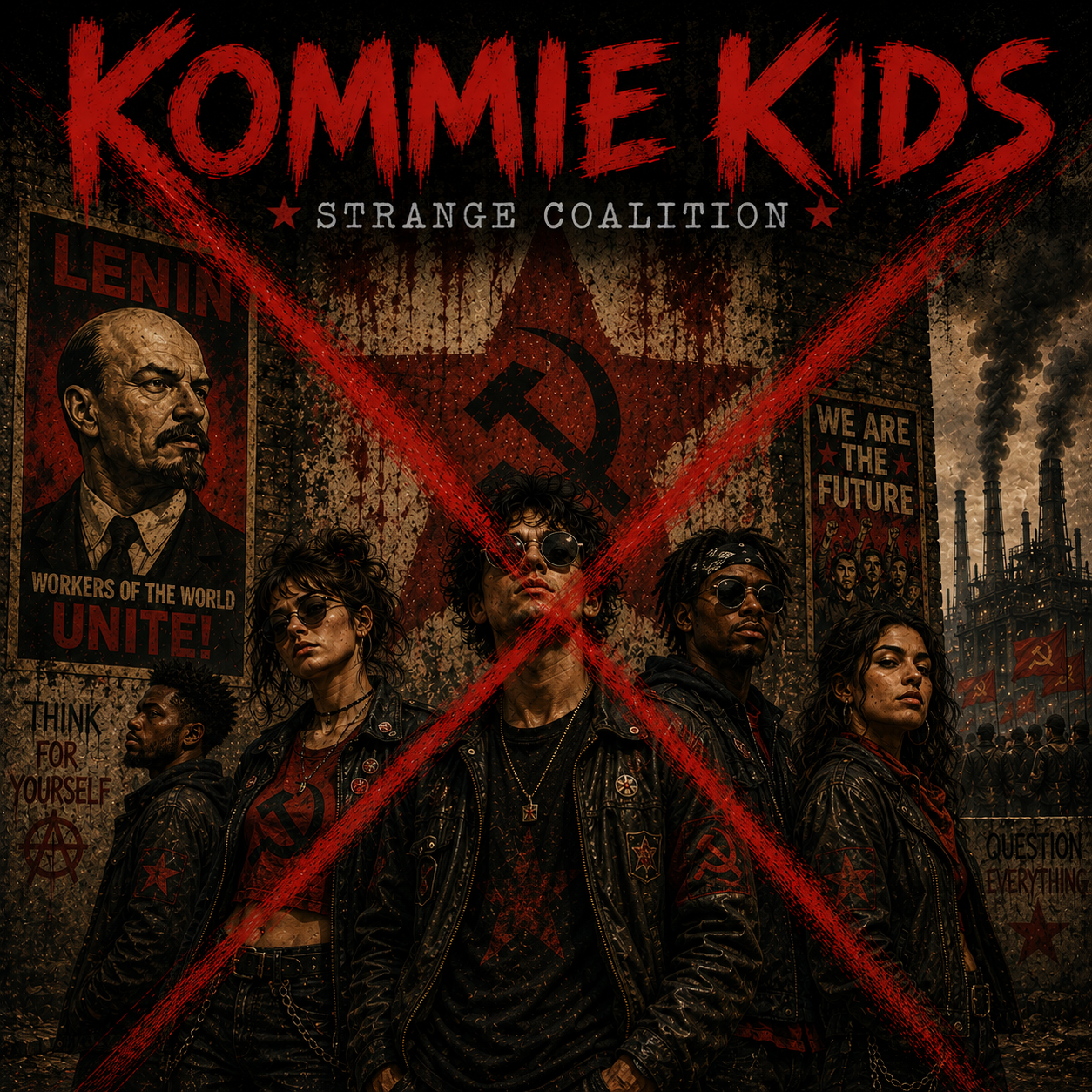
But I am putting the cart before the horse. The previous paragraphs should have been my closer. Lest you be in any doubt on where I stand on the subject, I also just released a new tune called Kommie Kids on Spotify, Apple, and anywhere you stream. But I digress. Let’s start from the beginning with our short story.
Karl Marx: Class War Becomes a Political Program
Published in 1848, The Communist Manifesto framed history as a struggle between classes and identified the modern conflict as one between the bourgeoisie, who owned productive property, and the proletariat, who sold their labor. The manifesto’s famous prescription was not simply a more generous welfare state. Marx and Engels called for the overthrow of bourgeois political supremacy and summarized the communist theory, in their own words, as the abolition of private property. They proposed taking over all the means of production and credit and putting it in the hands of the state. The de-facto destruction of capitalism. Marxism was revolutionary. It did not merely propose taxing capitalism to soften its edges. It treated capitalism itself as a class system to be destroyed.
Marx spent the last decades of his life in Britain, much of them in London, studying in the British Museum and analyzing the most advanced industrial economy of his day. His circumstances produced one of history’s great ironies. The leading theorist of anti-capitalism survived for years with financial help from Friedrich Engels, whose family owned a prosperous textile business. Engels returned to the firm, became a successful businessman, and used part of his income to support Marx and his family while Marx worked on Das Kapital. Another great irony is that a doctrine dedicated to abolishing capitalist ownership was sustained by profits generated inside the capitalist industrial system it condemned. This seemingly hypocritical relationship was consistent with Britain’s long history of exploiting divisions in rival states, and later British elites included socialists, Fabians, imperial reformers and geopolitical strategists whose ideas sometimes overlapped in surprising ways.
While the figure of 100 million deaths is widely associated with 1997 book, The Black Book of Communism, some historians dispute both the total and what should be counted as a death “caused by communism.” What is not seriously disputed is that communist governments and communist revolutionary movements were responsible for tens of millions of deaths through execution, forced labor, political terror, collectivization, famine aggravated or produced by policy, and war. The scale is vast even if one uses conservative estimates.
Lenin: From Theory to the One-Party State
While Karl Marx and Friedrich Engels were the principal architects of communism. Vladimir Lenin transformed Marxist theory into a practical doctrine for seizing and holding state power during the 1917 Bolshevik Revolution that toppled hundreds of years of czarist monarchy in Russia. Marx had expected socialist revolution to emerge from highly industrialized capitalist societies. Imperial Russia was comparatively backward, overwhelmingly rural and governed by an autocratic monarchy. Lenin adapted Marxism to those conditions.
The Bolsheviks violently dissolved the elected Constituent Assembly after failing to win a majority. Rival socialist parties were suppressed. Independent newspapers were closed. The Cheka, the new political police, became an instrument of terror. During the Russian Civil War, the regime used executions, hostage taking, confiscation and forced requisitioning against perceived enemies. The Bolsheviks described these measures as necessary to defend the revolution. That justification would become one of the recurring features of Marxist governments:
Brutality is excused because history is supposedly moving toward a utopian classless society.
Lenin viewed socialism as a potential starting point but never the final destination. It was the lower stage of communist society, a period in which the old capitalist order was dismantled and economic life reorganized. He preached that the existing bourgeois state had to be violently smashed rather than merely won through parliamentary competition. The result in Russia was not the “withering away” of the state but the creation of a regime far more brutal than the imperial czarism it replaced.
Stalin: Collectivization, Purges and the Gulag
Joseph Stalin took the machinery Lenin created and expanded it into a system of extraordinary, centralized power. He forced the collectivization of agriculture where peasants were dispossessed and forced into collective farms or deported or killed. Hunger spread and famine of 1932–33 devastated Ukraine and other agricultural regions of the Soviet Union where millions died or were murdered.
The terror then turned inward against the Communist Party itself, the military, intellectuals and ordinary citizens. During the Great Purge of the 1930s, show trials converted fabricated accusations into public theater, while secret police operations led to mass arrests, executions and deportations. Millions passed through the Gulag system of forced-labor camps. Some survived and returned; many did not.
The Soviet Union industrialized rapidly, allied with the United States and most of Europe to defeat Nazi Germany at staggering human cost and emerged as a military superpower. Those achievements temporarily coexisted with a system built on controlled information, political repression and law subordinate to the Communist Party power.
That system became a model for authoritarian revolutionary movements around the world. As if to leave no doubt about the nature of Communist law, Stalin famously said:
Show me the man and I’ll show you the crime.
The Soviet Union During the Cold War
After World War II, the Allies agreed to divide Europe into spheres of influence with half of Germany and most of the eastern nations being aligned with and controlled by the Soviet Union, and the rest by an alliance of the United States and western Europe. After Manhattan Project scientist and Communist spy Klaus Fuchs gave nuclear secrets to the Soviet Union, they built their nuclear weapons arsenal and emerged as one of the world’s two military superpowers.
Poland, East Germany, Czechoslovakia, Hungary, Romania and Bulgaria became one-party regimes in which opposition parties, independent media and much private economic activity were eliminated or brought under state control. When populations challenged Soviet domination, as in Hungary in 1956 and Czechoslovakia in 1968, Moscow used military force to suppress the uprisings. Internationally, the USSR competed with the United States for political and ideological influence throughout Europe, Asia, Africa and Latin America, supporting Communist governments and revolutionary movements while building an enormous nuclear arsenal.
After decades of failed centralized economic planning, technological stagnation and declining economic competitiveness, Mikhail Gorbachev attempted to rescue the system in 1985 through glasnost (greater openness) and perestroika (economic and political restructuring). But relaxing Communist Party control instead exposed the extent of the failure and depth of public dissatisfaction and accelerated nationalist and democratic movements throughout the Soviet bloc.
The Soviet Union collapses
The fall of the Berlin Wall in November 1989 became the defining symbol of Communism’s collapse in Europe. Once Gorbachev made clear that Soviet troops would no longer intervene to preserve Communist governments, regimes across Eastern Europe fell with remarkable speed. By December 1991, the Soviet Union itself had dissolved into fifteen independent countries. Russia initially attempted a transition toward competitive democracy and a capitalist market economy, but the chaotic privatizations of the 1990s produced enormous economic disruption and concentrated considerable wealth in the hands of politically connected oligarchs.
Putin and the Oligarchs
Under Vladimir Putin, who came to power at the end of 1999, Russia gradually moved back toward centralized authoritarian rule, with increasing control over television and other media, restrictions on political opposition, weakened judicial independence and manipulated elections and a bunch of plutonium tea assassinations along the way. While Russia today is not Communist, it remains a strongly authoritarian state surrounded by a fake shell trying to look like a democracy. It still has suppression of dissent, state-dominated media and powerful security services. It’s economy is in shambles, it’s in the midst of demographic collapse, it remains an ideological and military adversary of the United States and has the most nuclear weapons in the world.
The important lesson here is that Marxism doesn’t work to improve the life of people, but its authoritarian institutions survive and have become the model for authoritarian regimes around the world.
Mao’s China: Revolution on an Even Larger Scale
The Chinese Communist Party came to power in 1949 after decades of civil war, Japanese invasion and social breakdown. Mao Zedong drew heavily from Marx and Lenin but adapted communist revolution to a predominantly peasant society. Land confiscation destroyed the old rural landlord class, often through violent “struggle sessions” and executions. Private enterprise was absorbed into state control.
The most catastrophic experiment was the Great Leap Forward, launched in 1958. Mao sought to propel China rapidly into industrial and agricultural abundance through mass mobilization, rural communes and fantastically ambitious production targets. Local officials, fearful of reporting failure, exaggerated harvests. The state procured grain on the basis of false numbers. Labor was diverted into projects such as backyard steel production. Private farming and normal market signals were crushed. The resulting famine from 1958 to 1961 was one of the worst in recorded history. A Stanford review describes approximately 30 million deaths, while other major studies reach higher or lower totals.
Mao launched the Cultural Revolution in 1966, mobilizing youth, called the Red Guards to attack traditional culture and alleged counterrevolutionaries. Schools and universities were disrupted, officials and teachers were humiliated and beaten or killed. Millions were persecuted or displaced and the movement weakened only after years of chaos and military intervention.
Post-Mao China changed its economic methods dramatically. Beginning under Deng Xiaoping, capitalism was allowed to play a far greater role, which produced extraordinary growth, as it always does. Essential to Chinese economic success was President Bill Clinton (D) strongly supporting China’s entry into the World Trade Organization. “Capitalism with Chinese characteristics”, access to Western markets, cheap labor, huge foreign investment, a healthy amount of intellectual property theft and disregard for WTO rules, helped produce decades of extraordinary growth and eventually made China the world’s second-largest economy.
Just as it always does, capitalism significantly increased the living standards of the average citizen. China today remains an authoritarian state that controls the economy, major media, persecutes its ethnic minorities and crushes challenges to Communist Party rule. And it’s become a powerful adversary of the United States with nuclear weapons.
The important point here is the recognition of the economic failure of Marxism by its practitioners, who embraced the very system that it tries to destroy. But all the authoritarian architecture remains to control the people.
North Korea
North Korea emerged from the division of Korea at the end of World War II, when Soviet forces occupied the north and the United States occupied the south. In 1948, the Soviet-backed Democratic People’s Republic of Korea was established under Kim Il Sung, a Communist guerrilla leader who built a one-party state modeled on Stalinist systems in the Soviet Union and China. In 1950, North Korea invaded South Korea in an attempt to reunify the peninsula by force, beginning the Korean War. After the war ended in an armistice in 1953, Kim consolidated power through purges, political imprisonment, pervasive surveillance, and the elimination of opposition. Like its sponsors China and the Soviet Union, North Korea had all the features of a Communist state: state ownership of major industry, centralized economic planning, suppression of political and religious activity, and absolute control by the ruling Workers’ Party of Korea.
North Korea also illustrates how a revolutionary Communist state can become a hereditary dictatorship. Power passed from Kim Il Sung to his son Kim Jong Il and then to his grandson Kim Jong Un, producing one of the world’s most rigid and brutal political dynasties. The government has maintained an extensive system of prison camps, severe restrictions on movement and information, and collective punishment of families considered politically disloyal. Economic isolation and disastrous state policies contributed to the catastrophic famine of the 1990s, in which hundreds of thousands—and possibly far more—died from starvation and related causes. While limited private-market activity has since been tolerated out of necessity, the regime continues to claim Communist and socialist legitimacy while devoting enormous resources to its military and nuclear-weapons programs. North Korea is an example of the central problem with Marxist-Leninist political systems: once a ruling party abolishes competitive elections, private political organization, a free press, and independent centers of economic power, there are few institutional mechanisms left for citizens to remove failed leaders or resist abuses of state power.
Decades of US policy engagement, concessions, aid, and unenforced agreements allowed Pyongyang to buy time while preserving its nuclear ambitions. The 1994 Agreed Framework, signed by President Clinton, froze North Korea’s plutonium program in exchange for energy assistance and promised normalization, but North Korea still pursued a clandestine uranium-enrichment effort. Subsequent negotiations under both Republican and Democratic administrations repeatedly traded sanctions relief or assistance for promises of denuclearization that Pyongyang failed to fulfill. At the same time, weak verification, reluctance to impose decisive costs, and continued economic support from China reduced the pressure on the regime. These diplomatic efforts ultimately failed to prevent the regime from developing nuclear weapons, culminating in its first nuclear test in 2006. Now North Korea has about 60 nuclear warheads and ballistic missiles that can reach the United States. This should be a cautionary tale for Iran, and I support President Trump doing the tough work that his predecessors didn’t have the courage to do.
The lesson here is that Marxist regimes (and most authoritarians) view diplomacy as an opportunity to buy time to accomplish their actual goals.
Indochina: Vietnam, Cambodia and Laos
Ho Chi Minh and the Vietnamese communist movement fused nationalism with Marxism-Leninism. The struggle first targeted French colonial rule and later became entwined with the Cold War and the division between North and South Vietnam. After the fall of Saigon in 1975, Vietnam was unified under Communist Party rule.
The new government sent large numbers of former South Vietnamese military officers, officials and others to “reeducation” camps which combined political indoctrination with hard labor, deprivation and indefinite detention. The government also collectivized economic activity and moved people into “new economic zones.” Hundreds of thousands fled. The “boat people” crisis became one of the defining refugee stories of the late 1970s and 1980s.
Vietnam eventually liberalized much of its economy by allowing elements of capitalism in 1986, while preserving the Communist Party’s political monopoly. They emulated the Chinese model.
Again, the important pattern here is the recognition of the economic failure of Communism by its practitioners, who embraced the very system that it tries to destroy.
In contrast, Cambodia was a horrific failure. The Khmer Rouge, led by Pol Pot, seized power in 1975 and tried to create an agrarian revolutionary society almost overnight. Cities were emptied. Money and markets abolished. Families separated. Intellectuals, religious figures, ethnic minorities, former officials and countless ordinary people were treated as enemies. Forced labor, starvation, torture and execution followed. The U.S. Holocaust Memorial Museum estimates that approximately 1.7 million Cambodians died between 1975 and 1979—more than one quarter of the population. For an up close and personal view of the ugly horrors of Communism, I would encourage you watch the 1984 film, The Killing Fields. You won’t be the same after you watch how children were indoctrinated and turned on their parents and family who were killed by the regime.
Cuba, Latin America and the Export of Revolution
The Cuban Revolution, led by lawyer and activist Fidel Castro, began as a movement against the dictatorship of Fulgencio Batista. After violently seizing power in 1959, the new regime nationalized property, imprisoned and murdered rivals, brought the press and major institutions under state control, and aligned itself with the Soviet Union. In December 1961, Castro publicly declared himself Marxist-Leninist.
With massive help from the Soviet Union, Cuba became the most durable communist state in the Western Hemisphere and a key exporter of revolutionary ideology. It supported guerrilla movements and allied governments throughout Latin America. Moscow and Havana supplied training, money, weapons, political education and prestige to movements whose goal was to destroy capitalism and U.S. influence. Most movements failed but some became governments. The script was built on the same Marxist vocabulary of class struggle, anti-imperialism, expropriation and the creation of a new socialist order.
Domestically, the Castro regime continued to eliminate political competition and repress its people, while central planning destroyed a once vibrant economy. In the 1980s, waves of Cubans left and many ended up in Florida which now boasts a large and thriving community. Our Secretary of State, Marco Rubio, is the son of such Cuban immigrants.
Venezuela
Venezuela is a dramatic example of how authoritarian socialism hollows out once-wealthy economies. Hugo Chávez, elected president in 1998, launched his “Bolivarian Revolution,” expanding social programs while concentrating political power, nationalizing private businesses and foreign-owned assets, imposing tight economic controls. High oil prices initially helped finance the system and reduced poverty, but Chávez’s government also fired thousands of experienced oil industry employees after the 2002–03 strike and increasingly used the company to fund government priorities rather than maintain production and investment.
After Chávez’s death in 2013, Nicolás Maduro continued the system as falling oil prices, declining production, currency controls, deficit spending and severe economic mismanagement contributed to hyperinflation and economic collapse; the IMF estimates Venezuela’s economy contracted by roughly 75% between 2013 and 2021, an extraordinary decline for a country not at war.
After decades of previous US Presidents tolerating the proliferation of Marxism and the steadily rising presence and influence of its adversaries Russia and China in its own backyard, President Trump has drastically and quickly changed the momentum. On Jan 3 of this year, convicted narco-trafficker and President Nicolas Maduro was captured by a well-orchestrated military operation and now sits in a New York jail awaiting trial. The remaining government is now subservient to US interests and no longer exports oil to our adversaries, most importantly Cuba whose economy is on the verge of collapse.
The important lessons here are that Venezuela shows what happens when a country elects Marxist-Socialist leaders, and that it’s our national interest to resist the proliferation of Marxism in the Western Hemisphere.
Marxism Comes to America through the Democrat Party
The road to power for Marxism in America has been slow and steady and has been accomplished mostly within our electoral process and infiltration of one the two major political parties in the US; the Democrat party. Some people will cringe at this, but the fact is the Marxists chose the Democrats, not the GOP as its pathway. Like the Marxist revolutionary movements before it, the Democratic Socialists of America have adapted their tactics to its host country. In the US, it has infiltrated our college campuses and worked relentlessly to elect politicians to local, state and federal positions. But before we pull further on this thread, I think it will be instructive to retrace the steps that Marxism has taken in our country.
It’s the eve of the Civil War. The Congressional representatives representing what soon would become the Confederate states, were all members of the Democrat Party, and when combined with sympathetic representatives from other states, the pro-slavery coalition could command a majority of Congress. When the Confederacy was defeated and the awful sin of slavery was bloodily and finally abolished, the Democrat party needed a new message.
The Democratic Party After the Civil War
After the Civil War, the Democrat Party rebuilt its national strength around the “Solid South,” where white Southern Democrats opposed Republican Reconstruction. After federal troops withdrew in 1877, southern states established a political order based on racial segregation through Jim Crow laws. At the same time, the emerging American labor movement was gaining steam and was supported by populist and socialist movements. By the early 20th century, organized labor increasingly found allies among progressive Democrats, including Franklin Roosevelt’s whose New Deal policy elevated the labor movement and created social welfare programs, that while addressing a legitimate need at the time, have become a moral hazard and a massive fiscal burden that now consumes 65% of federal budget today.
In 1948, segregationist Southern Democrats broke away to form the States Rights Democratic Party (a.k.a. the “Dixiecrats) and nominated South Carolina governor Strom Thurmond for president specifically to oppose President Harry Truman’s civil-rights program and federal efforts to dismantle segregation. Over the following two decades, civil rights increasingly divided the parties and ultimately helped dismantle the old Solid South, fundamentally reshaping the political coalitions of both Democrats and Republicans.
In the early days, American Marxists were passionate activists who participated in strikes, organized in labor unions, recruited writers, artists, students and intellectuals. They sought alliances with liberals and other left-wing factions. It’s possible to acknowledge those contributions without ignoring the party’s larger allegiance to the Marxist cause. State Department records from the 1930s document American Communist leader Earl Browder speaking at the Comintern in Moscow about organizing workers, farmers and a broad united front. The party was not simply an indigenous reform club that happened to admire the Soviet Union from afar. It belonged to an international communist movement whose center of gravity was Moscow.
That doesn’t mean every American Communist was or is a spy. But espionage is also not a fantasy invented by Republicans. The declassified VENONA intercepts later demonstrated extensive Soviet intelligence contacts in the United States and documented espionage activity involving members of the American Communist Party. McCarthy-era accusations were often reckless and destructive, yet genuine Soviet espionage and genuine Communist Party ties to Moscow also existed.
The ideological issue is separate from the espionage issue. A person doesn’t need to be a Russian or Chinese agent to believe that capitalism should be dismantled, or that Marxism experiment represents a more advanced social order. The American constitutional system protects even radical and anti-capitalist beliefs, a feature noticeably absent from Marxism and all its variants. The limit in the US is when leftist policies conflict with our Constitution or devolves into lawlessness and violence. The early days of the labor movement involved plenty of violence by both management and labor.
Labor, Hollywood and the Battle Over Culture
The American labor movement was never synonymous with communism. The great majority of union members were not Communists, and major labor leaders fought bitterly over communist influence. Still, communists were effective organizers in some of the new industrial unions of the 1930s. Their discipline, willingness to work in difficult industries and focus on racial and class grievances gave them influence beyond their membership numbers.
Hollywood became the more visible cultural battlefield. During the Depression and World War II years, the Communist Party attracted screenwriters, actors and directors who saw it as militant opposition to fascism, racism and economic inequality. Some were formal party members; others moved in Communist-led organizations or Popular Front circles without joining.
In 1947, the House Un-American Activities Committee held hearings into Communist influence in the film industry. Ten screenwriters and directors (the Hollywood Ten) refused to answer questions about Communist Party membership and were convicted of contempt of Congress. The studios then created a blacklist that deprived many people of work. The blacklist expanded far beyond proven espionage and punished association, refusal to cooperate and suspected political belief. That was a civil liberties failure, but still a stark contrast to the absence of civil liberties in Communism. Recognizing the excesses of the blacklist should not require pretending that Communist influence in Hollywood was imaginary. The Communist Party consciously treated culture as a political arena, and some prominent artists were members or sympathizers.
Youth-led Democratic Socialism on the Rise in America
Today the most visible organized Marxist movement in the United States is not the Communist Party but the Democratic Socialists of America (DSA). The DSA is the largest socialist organization in the United States, with over 100,000 members and chapters in all 50 states. Bernie Sanders is the godfather of modern Democratic Socialists and has a growing list of young Congressional acolytes like Alexandria Ocasio-Cortez, Rashida Tlaib and Ayanna Pressley. That list could grow substantially given the notable victories by DSA House candidates in NY, MI, CO and PA. These deep blue districts all but guarantee the DSA will increase its congressional footprint from four to nine.
Fourteen (14) state legislators publicly identify as DSA members. At the local level, there is a growing list of mayors and city executives, most notably Zohran Mamdani the DSA member of New York City. If you live in any deep blue state, your future is more DSA policies.
And what exactly are those policies you ask? Well I just happen to have a list from their current platform:
Abolish the Senate filibuster therefore eliminating the 60-vote threshold for major legislation to pass.
Make Washington DC and Puerto Rico new states, effectively adding 4 new Senators, effectively giving the Democrats a permanent majority.
Abolish the Senate, expand the House of Representatives, implement proportional representation and ranked-choice voting, and move to a multi-party system (constitutional amendment required for Senate)
Abolish the Supreme Court and President replacing it with an executive and judiciary chosen by and subordinate to Congress (constitutional amendment required.)
Abolish the Electoral College (constitutional amendment required)
Extend full voting rights to non-citizen U.S. (constitutional amendment required)
Establish public ownership of the largest corporations and essential industries. NVIDIA, Google, Amazon, General Electric all owned by Uncle Sam, or better Comrade Vlad. (constitutional amendment required)
Universal healthcare at no cost to individuals, with expanded public hospitals and clinics and free medical education and training.
Free, public education from pre-K through college, plus cancellation of all student debt.
Major expansion of public housing. Go for a drive and look at the state of public housing projects and tell me if you want that in your neighborhood
A New Green New Deal with a federal jobs guarantee, massive public investment in solar and wind energy and transit, phase-out of fossil fuels, and public ownership of major energy infrastructure.
Abolish the police and prison system.
Abolish Immigration and Customs Enforcement. Open borders forever. (constitutional amendment required)
Enact aggressive wealth taxes on the richest individuals and corporations. With their insane expansion of the scope and cost of government, if you think these wealth taxes will stay at the level at the very rich, who will just move away, I have some swamp land to sell you. (constitutional amendment required)
Abolish the Department of Defense (constitutional amendment required)
Major tax increase on high-income individuals, major corporations. If you’re reading this you probably fall into the category of “high-income.”
Massive expansion of the Obama-Biden Diversity Equity Inclusion (DEI) policies including federal reparations for slavery.
Does any of this sound reasonable? Is it affordable in a country already $40 trillion in debt? Never mind that much of it is unconstitutional, it seems like a recipe for civil war. And to give you an idea how motivated these young Marxists are, watch this video by DSA National Political Committee member, Cliff Connolly, who says:
“The class war is a guerrilla war. This strategy is not focused on winning individual battles but using them to advance our position slowly and surely until our enemy is bled dry.”
Sound like people we should negotiate with? Are you OK with 15% unemployment and a $5 trillion federal deficit? How about annual inflation of 15% and gas at $11 /gallon? How about an annual wealth tax of 3-5% on your IRA holdings that is top of the new 50% top federal income tax rate? How about regular power blackouts in major cities? This is what would be in store for the United States if we let these Krazy Kommie Kids into power.
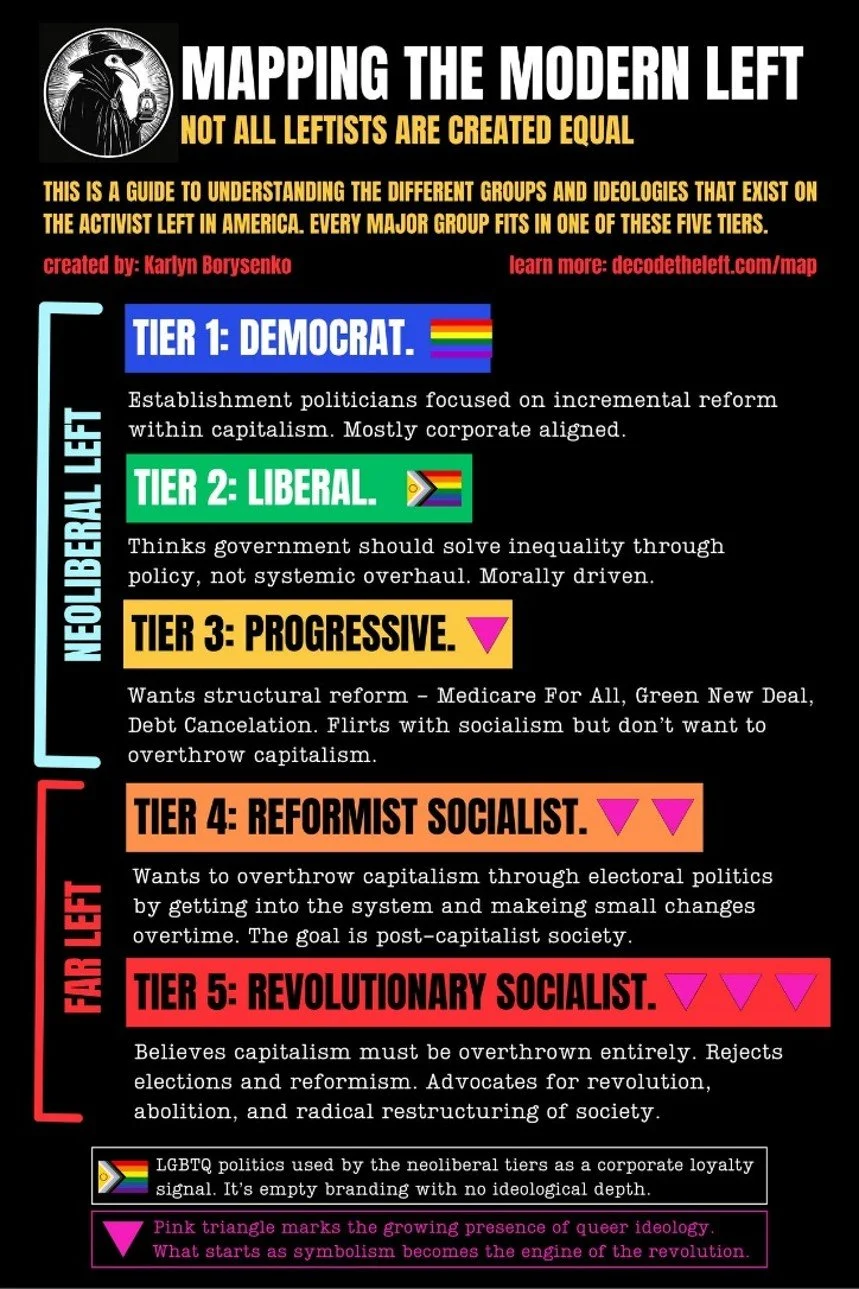
Here’s a valuable visual that traces the constituency of the left wing in America, courtesy of Karlyn Boroshenko.
Conclusion
So, what can you do to resist this movement to destroy our American way of life? Well, the first thing to do is vote. Especially in November’s mid-term elections. If you are a traditional Democrat voter that also fears the rise of Socialism, you need to think long and hard about checking the box for any Democrat because the Party is increasingly being influenced by the DSA. If you are a traditional GOP voter or independent, you need to hold your nose and vote for GOP candidates because none of them are Marxists. All you Trump haters our there, and there are legitimate reasons to dislike him, don’t make the mid-terms a referendum because the stakes are too high. Hold your nose and vote for anything that isn’t a Democrat. That rule applies until they take out the trash in their own party once and for all. Are you listening Hakeem Jefferies and Chuck Schumer? Clean your house of the DSA, DEI, the defund the police, trans everything, the open borders and America will start listening to you again. Until then, you should be defeated not compromised with.
Another critical thing we must do is reform our public schools and universities so that they stop indoctrinating our kids with divisive, awful and wrong ideas about America. I’ve been writing for years about the terrible state of our public schools and now we are tasting the rotted fruit this tree is yielding. In an August 2026 YouGov poll, 42% of Americans ages 18 to 29 said they had a favorable view of socialism, compared with only 26% who viewed it unfavorably. If you know some young folks who are in the 42%, pass on this essay and encourage them to comment and I will be happy to engage.
All Marxist revolutions start with the youth. Mold them. Make them your foot soldiers. Useful idiots. Instead, teach kids the truth about the brutal history of Marxism and all its forms like my Dad did as a high school teacher in the 1960’s and 1970’s. I still have some of those textbooks in my home library. You can advocate for teaching about Marxism in our schools again. You’ll have to fight the extremely powerful Teachers Unions, but it’s worth the fight. Do like Florida Governor Ron DeSantis did a few weeks ago by signing legislation that mandates that kids learn about the evils of Marxism starting this fall. DeSantis has been consistent:
"The truth will set us free. We will not allow our students to live in ignorance, nor be indoctrinated by Communist apologists in schools. The DSA may try to make Castro out to be a HERO - but FLORIDA students know better!"
Final Thoughts
My point with this article is not that Americans should be forbidden to call themselves socialists or communists. The Constitution protects their right to do so. The point is that Americans should know what these words mean, and what political movements using them have actually built, and what it means when they say openly that capitalism should be abolished in favor of Zohran Mamdani’s “warmth of collectivism”.
The American constitutional order is simply not compatible with Marxism: a one-party state claiming a monopoly on truth, suppressing rival parties, controlling the press, subordinating courts to the ruling party, restricting religious activity, confiscating property and crushing dissent. The Constitution divides power among competing institutions rather than vesting final authority in a single party. Article IV guarantees the states a republican form of government, popular sovereignty, with elected representatives accountable to the people. The Constitutional Republic of the United States, with its emphasis on personal and economic freedom and capitalism, has produced the greatest wealth, innovation and has raised the living standards of its citizens, more than any other nation or empire in history.
A free society depends on skepticism toward any movement that asks people to surrender independent institutions in exchange for a promised future. Marxism’s record is a severe warning because its utopian dream repeatedly justifies brutality. The twentieth century supplied more than enough evidence of the danger.
The American alternative is not perfection. Capitalism produces inequality, crises, sometimes concentrated corporate power and legitimate grievances. Democracy can be noisy and slow. But a constitutional system can correct itself because no party, class or ideology is supposed to possess final authority. Elections remove governments, courts restrain power, newspapers expose failure, and citizens organize against those in charge. Those safeguards prevent mob rule and keep democracy from becoming a slogan attached to a one-party state. The central distinction is between a political order that allows power to be challenged and one that decides in advance who may challenge it. That’s worth remembering whenever a horrible old ideology returns in new softer language.
As I sing in my punk anthem, Kommie Kids,
“Bad ideas don’t get better with age.”